

2.4 Resources

“Love God and do what you will.”
This famous quote from Augustine of Hippo (534-430) is commonly interpreted to mean if we love God, then what He wants will become what we want—and what we want will invariably be what He wants. Thus, if we want it, whatever it might be, it is within the will of God. In effect, God yields His providence to the sovereignty of our feelings, our wishes, our desires. Ethics becomes a subjective enterprise.
Reading the quote in context however, reveals an entirely different meaning. Found in the tract, In epistulam Ioannis ad Parthos (Tractatus VII, 8), the passage reads: “Once for all, then, a short precept is given unto you: Love God, and do what you will: whether you hold your peace, through love hold your peace; whether you cry out, through love cry out; whether you correct, through love correct; whether you spare, through love do you spare: In all things, let the root of love be within, for of this root can nothing spring but what is good.”
In other words, Augustine is arguing objectively rather than subjectively – that when the love of God is the governing principle of our lives, then all that we think, say, and do will necessarily be yielded to that love. If our love of God is real and profound, then obedience and faithfulness, right thinking and right actions will flow irresistibly from that love.
Perhaps, what he had in mind was to expound on Paul’s exhortation in 1 Corinthians 16:14, “Let all that you do be done in love.” And that is quite the opposite of saying that if we love God, then what He wants will become what we want.
Context can make all the difference in the world.
“Love God and do what you will.”
https://www.kingsmeadow.com/wp/love-god-and-do-what-you-will/
Pride
A person’s pride will humble them, but a humble spirit will gain honour.
(Proverbs 29:23)
I can remember when I was young, my mother telling me to be proud of myself for winning a race or achieving a high mark. At other times when I was showing off for the same things my mother would say, ‘people will think you have a big head!’ It is a fine line between being proud of achievements and being humble and not boastful.
We focus on our holiness and becoming all that God has created us to be, but what stands in the way of becoming holy?
Our pride can stand in the way of us being all that we can be. Pride is an overly high opinion of yourself. Pride has consequences.
- You may know that you have offended someone, but pride holds you back from asking forgiveness.
- You may realise you need to mend a broken relationship, but pride will lead you to deny that.
- You may know you are living a sinful lifestyle, but pride will discourage you from admitting it.
- Pride will convince you that you deserve better treatment.
- Pride will hold you back from serving others.
- Instead, pride will have you striving for places of prominence and to be recognised for all you do.
- Because of pride you may see yourself through the eyes of the world and through the lens of others’ opinions.
- Humility, on the other hand, is pleasing to God and scripture says it places your life in a position where God will honour you.
When we focus on the death and resurrection of Jesus we see the perfect example of humility, in laying his life down for the sins of the world and overcoming the power of sin and death for each one of us. Humility is a foundation for holiness but a very hard virtue to understand, choose and live. It can only be learned through the often-painful circumstances of daily life. Humility is something we all struggle with.
St. Thomas Aquinas said, “Humility means seeing ourselves as God sees us: knowing every good we have comes from Him as pure gift.”
In other words being humble means acknowledging your abilities and your flaws in the same way, being honest with what you do have and equally honest with what you don’t have.
by Bruce Downes, “The Catholic Guy” ministry
Seven Scientific Facts About the Benefit of Doing Good
26 January 2017
Doing good benefits us mentally, physically, and emotionally.
Have you ever felt a rush after doing a good deed? Ever noticed you were more relaxed after a day of volunteering? Did you ever feel motivated to do good after thinking about the last time you helped someone? If you answered ‘yes’ to any of these questions, there’s a good explanation for why – it’s called science.
International Good Deeds Day is almost upon us and it’s time to start rallying your friends, family, coworkers, and peers to join this global movement of doing good on April 10, 2016. If your fellow good doers are still in need of some convincing, here are seven scientific facts about the benefits of doing good to share with them.
- Doing Good Decreases Stress
According to a 2013 study examining the relationship between volunteering and hypertension, giving back can have a significant impact on blood pressure. Researchers found that adults over 50 who volunteered about four hours a week were 40 percent less likely than non-volunteers to have developed hypertension four years later. Additionally, being generous can have the same effect, according to a 2010 study, which found that the less money people gave away, the higher their cortisol levels. Volunteering has been found to lower blood pressure.
- Doing Good Increases Life-Expectancy
Yes, it’s true. Researchers from the University of Buffalo found a link between giving, unselfishness and a lower risk of early death. The findings show that subjects who provided tangible assistance to friends or family members (running errands, helping with child care, etc.), reported less stressful events and, consequently, had reduced mortality. In other words, “helping others reduced mortality specifically by buffering the association between stress and mortality.”
- Doing Good Makes Us Feel Better
Ever felt a sort of “rush” after performing a good deed? That sensation is known as ‘helper’s high’ and is produced when your brain releases endorphins, the feel-good chemicals of the brain. When you do something good for someone else, your brain’s pleasure centers light up, releasing endorphin and producing this high. Not to mention, doing good has also been known to generate feelings of satisfaction and gratitude. Helping others generates a feeling similar to a ‘runner’s high,’ where the brain’s pleasure centers light up
- Doing Good Makes Us Happier At Work
According to a study from the University of Wisconsin-Madison, altruists in the office are more likely to be committed to their work and less likely to quit their jobs. The researchers also found that individuals in their mid-30s who rated helping others in their work as important, reported they were happier with their life when surveyed 30 years later.Overall, the study came to an important conclusion about office altruism: those who help others are happier at work than those who don’t prioritize helping others.
- Doing Good Promotes Mental Health
The results are in! After an extensive review of 40 studies on the effect of volunteering on general health and happiness, the BMC Public Health journal has concluded that volunteering is also good for mental health. The review found that – along with improved well-being and life satisfaction – volunteering is also linked to decreased depression.
- Doing Good Leads To Happiness
“People who engage in kind acts become happier over time.” It’s that simple, according to Sonja Lyubomirsky, Ph.D, a professor of psychology at the University of California, Riverside. Lyubomirsky, who has studied happiness for over 20 years, found that performing positive acts once a week led to the most happiness.
In addition, Researcher Stephen Post of Case Western Reserve University School of Medicine found that when we give of ourselves, everything from life satisfaction to self-realization and physical health is significantly improved. Doing a good deed just once a week can lead to greater happiness
- Doing Good Will Motivate You To Do Good Again
A 2012 study published in Psychological Science found that thinking about times you’ve helped others will make you want to help others again. The research found that reflecting on your past good deeds makes you feel selfless and want to help more, as compared to reflecting on the times others have helped you. In other words, thinking about what you’ve given others – and not only what you’ve received – will motivate you to do good again and again.
https://www.goodnet.org/articles/7-scientific-facts-about-benefit-doing-good
Teresa of Ávila
Teresa of Ávila was born Teresa Ali Fatim Corella Sanchez de Capeda y Ahumada in Ávila, Spain. Teresa’s father was rigidly honest and pious, but he may have carried his strictness to extremes. Teresa’s mother loved romance novels but because her husband objected to these fanciful books, she hid the books from him. This put Teresa in the middle — especially since she liked the romances too. Her father told her never to lie but her mother told her not to tell her father. Later she said she was always afraid that no matter what she did she was going to do everything wrong and was convinced that she was a horrible sinner.
As a teenager, she cared only about boys, clothes, flirting, and rebelling. When she was sixteen her father decided she was out of control and sent her to a convent. At first she hated it but eventually she began to enjoy it – partly because of her growing love for God, and partly because the convent was a lot less strict than her father.
However, when the time came for her to choose between marriage and religious life, she had a tough time making the decision. She’d watched a difficult marriage ruin her mother. On the other hand being a nun didn’t seem like much fun. When she finally chose religious life, she did so because she though that it was the only safe place for someone as prone to sin as she was.
Once installed at the Carmelite convent permanently, she started to learn and practice mental prayer, in which she “tried as hard as I could to keep Jesus Christ present within me … my imagination is so dull that I had no talent for imagining or coming up with great theological thoughts.” Teresa prayed this way off and on for eighteen years without feeling that she was getting results. Part of the reason for her trouble was that the convent was not the safe place she assumed it would be.
Many women who had no place else to go wound up at the convent, whether they had vocations or not. They were encouraged to stay away from the convents for long period of time to cut down on expenses. Nuns would arrange their veils attractively and wear jewelry. Teresa suffered the same problem that Francis of Assisi did — she was too charming. Everyone liked her and she liked to be liked. She found it too easy to slip into a worldly life and ignore God. The convent encouraged her to have visitors to whom she would teach mental prayer because their gifts helped the community economy. But Teresa got more involved in flattery, vanity and gossip than spiritual guidance. These weren’t great sins perhaps but they kept her from God.
Then Teresa fell ill with malaria. When she had a seizure, people were so sure she was dead that after she woke up four days later she learned they had dug a grave for her. Afterwards she was paralysed for three years and was never completely well. Yet instead of helping her spiritually, her sickness became an excuse to stop her prayer completely: she couldn’t be alone enough, she wasn’t healthy enough, and so forth. Later she would say, “Prayer is an act of love, words are not needed. Even if sickness distracts from thoughts, all that is needed is the will to love.”
For years she hardly prayed at all “under the guise of humility.” She thought, as a wicked sinner, she didn’t deserve to get favours from God. But turning away from prayer was like “a baby turning from its mother’s breasts, what can be expected but death?”
When she was 41, a priest convinced her to go back to her prayer, but she still found it difficult. “I was more anxious for the hour of prayer to be over than I was to remain there. I don’t know what heavy penance I would not have gladly undertaken rather than practice prayer.” She was distracted often: “This intellect is so wild that it doesn’t seem to be anything else than a frantic madman no one can tie down.” Teresa sympathises with those who have a difficult time in prayer: “All the trials we endure cannot be compared to these interior battles.”
Yet her experience gives us wonderful descriptions of mental prayer: “For mental prayer in my opinion is nothing else than an intimate sharing between friends; it means taking time frequently to be alone with Him who we know loves us. The important thing is not to think much but to love much and so do that which best stirs you to love. Love is not great delight but desire to please God in everything.”
As she started to pray again, God gave her spiritual delights: the prayer of quiet where God’s presence overwhelmed her senses, raptures where God overcame her with glorious foolishness, prayer of union where she felt the sun of God melt her soul away. Sometimes her whole body was raised from the ground. If she felt God was going to levitate her body, she stretched out on the floor and called the nuns to sit on her and hold her down. Far from being excited about these events, she “begged God very much not to give me any more favours in public.”
In her books, she analyses and dissects mystical experiences the way a scientist would. She never saw these gifts as rewards from God but the way he “chastised” her. The more love she felt the harder it was to offend God. She says, “The memory of the favour God has granted does more to bring such a person back to God than all the infernal punishments imaginable.”
Her biggest fault was her friendships. Though she wasn’t sinning, she was very attached to her friends until God told her “No longer do I want you to converse with human beings but with angels.” In an instant he gave her the freedom that she had been unable to achieve through years of effort. After that God always came first in her life.
Some friends, however, did not like what was happening to her and got together to discuss some “remedy” for her. Concluding that she had been deluded by the devil, they sent a Jesuit to analyse her. The Jesuit reassured her that her experiences were from God but soon everyone knew about her and was making fun of her.
One confessor was so sure that the visions were from the devil that he told her to make an obscene gesture called the fig every time she had a vision of Jesus. She cringed but did as she was ordered, all the time apologising to Jesus. Fortunately, Jesus didn’t seem upset but told her that she was right to obey her confessor. In her autobiography she would say, “I am more afraid of those who are terrified of the devil than I am of the devil himself.” The devil was not to be feared but fought by talking more about God.
Teresa felt that the best evidence that her delights came from God was that the experiences gave her peace, inspiration, and encouragement. “If these effects are not present I would greatly doubt that the raptures come from God; on the contrary I would fear lest they be caused by rabies.”
Sometimes, however, she couldn’t avoid complaining to her closest Friend about the hostility and gossip that surrounded her. When Jesus told her, “Teresa, that’s how I treat my friends” Teresa responded, “No wonder you have so few friends.” But since Christ has so few friends, she felt they should be good ones. And that’s why she decided to reform her Carmelite order.
At the age of 43, she became determined to found a new convent that went back to the basics of a contemplative order: a simple life of poverty devoted to prayer. This doesn’t sound like a big deal, right? Wrong.
When plans leaked out about her first convent, St. Joseph’s, she was denounced from the pulpit, told by her sisters she should raise money for the convent she was already in, and threatened with the Inquisition. The town started legal proceedings against her, all because she wanted to try a simple life of prayer. In the face of this open war, she went ahead calmly, as if nothing was wrong, trusting in God. “May God protect me from gloomy saints,” Teresa said, and that’s how she ran her convent. To her, spiritual life was an attitude of love, not a rule.
Although she proclaimed poverty, she believed in work, not in begging. She believed in obedience to God more than penance. If you do something wrong, don’t punish yourself – change. When someone felt depressed, her advice was that she go some place where she could see the sky and take a walk. When someone was shocked that she was going to eat well, she answered, “There’s a time for partridge and a time for penance.” To her brother’s wish to meditate on hell, she answered, “Don’t.”
Once she had her own convent, she could lead a life of peace, right? Wrong again. Teresa believed that the most powerful and acceptable prayer was that prayer that leads to action. Good effects were better than pious sensations that only make the person praying feel good.
At St. Joseph’s, she spent much of her time writing her Life. She wrote this book not for fun but because she was ordered to. Many people questioned her experiences and this book would clear her or condemn her. Because of this, she used a lot of camouflage in the book, following a profound thought with the statement, “But what do I know. I’m just a wretched woman.” The Inquisition liked what they read and cleared her.
At 51, she felt it was time to spread her reform movement. She braved burning sun, ice and snow, thieves, and rat-infested inns to found more convents. But those obstacles were easy compared to what she faced from her brothers and sisters in religious life. She was called “a restless disobedient gadabout who has gone about teaching as though she were a professor” by the papal nuncio. When her former convent voted her in as prioress, the leader of the Carmelite order excommunicated the nuns. A vicar general stationed an officer of the law outside the door to keep her out. The other religious orders opposed her wherever she went. She often had to enter a town secretly in the middle of the night to avoid causing a riot.
And the help they received was sometimes worse than the hostility. A princess ordered Teresa to found a convent and then showed up at the door with luggage and maids. When Teresa refused to order her nuns to wait on the princess on their knees, the princess denounced Teresa to the Inquisition. In another town, they arrived at their new house in the middle of the night, only to wake up the next morning to find that one wall of the building was missing.
Why was everyone so upset? Teresa said, “Truly it seems that now there are no more of those considered mad for being true lovers of Christ.” No one in religious orders or in the world wanted Teresa reminding them of the way God said they should live.
Teresa looked on these difficulties as good publicity. Soon she had postulants clamouring to get into her reform convents. Many people thought about what she said and wanted to learn about prayer from her. Soon her ideas about prayer swept not only through Spain but all of Europe.
In 1582, she was invited to found a convent by an Archbishop but when she arrived in the middle of the pouring rain, he ordered her to leave. “And the weather so delightful too” was Teresa’s comment. Though very ill, she was commanded to attend a noblewoman giving birth. By the time they got there, the baby had already arrived so, as Teresa said, “The saint won’t be needed after all.” Too ill to leave, she died on 4 October at the age of 67.
She is the founder of the Discalced Carmelites. In 1970 she was declared a Doctor of the Church for her writing and teaching on prayer, one of four women to be honoured by the Church in this way.
www.catholic.org/saints/
The adventure by John O’Connor
“If you aspire to serve the Lord, prepare yourself for an ordeal” Sirach 2:1
There are a variety of translations for the original Hebrew translated here as “ordeal.” Some say, “prepare yourself for testing,” or “prepare yourself for temptation.”
Every time you read this passage imagine that Jesus is saying to you: “(Your name), if you aspire to serve me, prepare yourself for an adventure”.
In another scripture, Jesus is saying: “I have come that you may have life, and have it in abundance!” (John 10:10) This contrasts greatly with a common perception of Christianity as a nice, polite, comfortable and regulated life. Who wants such a weak existence when a robust adventure is offered?
Wisdom 2:12-22 develops the abundant adventure theme in a way that might not be so attractive … “Let us lie in wait for the virtuous man, since he annoys us… Before us he stands, a reproof to our way of thinking, the very sight of him weighs our spirits down; his way of life is not like other people’s, the paths he treads are unfamiliar. Then in John 7:1-30 … “Jesus stayed in Galilee; he could not stay in Judaea, because the Jews were out to kill him” and concludes “They would have arrested him then, but because his time had not yet come no one laid a hand on him”. If you aspire to follow Jesus, prepare yourself for an adventure.
This quote comes from Luigi Giussani: “the circumstance that I am in, whatever they are, however difficult or unwanted, God allows me to be in for my maturity”. So if I want to be mature in faith (and I do) then I need to see the circumstances I am in, whatever they are, however blue or grey or black, as the place where Jesus is working in me, moulding me into His image.
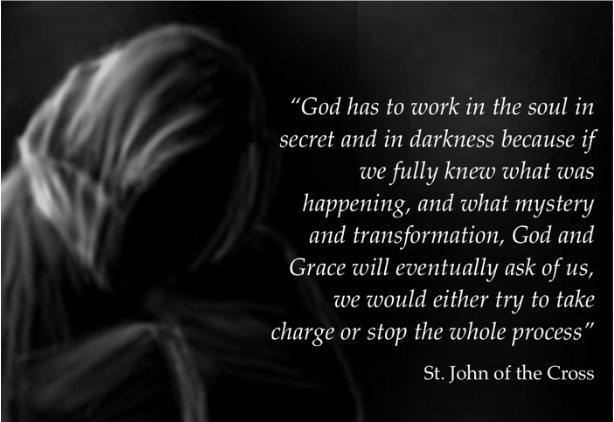
I suppose that another way of thinking of it is that while it is true to say we have been created by God, it is even more true to say that every day we are being created by God. I like that image since every day I do feel this creative act happening, sometimes a tender embrace, sometimes a hard moulding with some sudden and shocking realignments. Sometimes I co-operate with the creative action of God and other times I resist. I remember what I was like a year or five ago and see that I am changed, moulded by the circumstances that have made up my life to this point. Sometimes God works in the light. But other times it seems God prefers to work in my darkness. While I might prefer the light, the darkness is not a problem, as I know that while in darkness I am being formed in the tender embrace of Jesus.
Below is the full passage from Sirach (Ecclesiasticus):
My child, if you aspire to serve the Lord, prepare yourself for an ordeal. Be sincere of heart, be steadfast, and do not be alarmed when disaster comes.
Cling to Him and do not leave Him, so that you may be honored at the end of your days. Whatever happens to you, accept it, and in the uncertainties of your humble state, be patient, since gold is tested in the fire and chosen in the furnace of humiliation.
Trust Him and He will uphold you, follow a straight path and hope in him.
Sirach 2
You who fear the Lord, wait for his mercy; do not turn aside, for fear you fall. You who fear the Lord, trust him, and you will not be robbed of your reward. You who fear the Lord, hope for those good gifts of His, everlasting joy and mercy.
Look at the generations of old and see: whoever trusted in the Lord and was put to shame? Or whoever, steadfastly fearing him, was forsaken? Or whoever called him and was ignored? For the Lord is compassionate and merciful, He forgives sins and saves in the time of distress